

You’ve been thinking about ear pinning surgery, but one question keeps coming back to you: what if something goes wrong? Maybe you’ve read some scary stories online, or the idea of surgery near your face feels bigger than a procedure somewhere else on your body. That hesitation is completely natural.
Here’s the reassuring truth. Otoplasty (ear reshaping surgery) is one of the safest and most consistently satisfying cosmetic procedures performed today, with 97% of patients on RealSelf rating ear surgery “Worth It.”
A 2026 clinical review of 18 studies and 1,590 patients found that serious complications requiring revision occurred in only 2.1% of cases. The International Society of Aesthetic Plastic Surgery (ISAPS) 2024 Global Survey also confirms ear surgery is a well-established, widely performed procedure, with over 363,000 otoplasty procedures carried out by plastic surgeons worldwide in 2024 alone, a 3.8% increase from 2023.
At Aesthetic Arts Surgical Arts in Commerce, Georgia, triple board-certified surgeon Dr. Michael Kluska, DO, FAACS, FACOS, brings over 25 years of experience and Cleveland Clinic training to every otoplasty procedure. He believes honest conversations about risks are the foundation of great outcomes. This guide walks you through every concern, from scarring and pain to overcorrection and when to call your surgeon, so you can decide with confidence.
5 Key Facts About Otoplasty Safety
- Otoplasty has a 97% “Worth It” rating on RealSelf, making it one of the most consistently satisfying cosmetic procedures available today.
- Serious complications like infection (2 to 3%) and hematoma (1 to 3%) are rare, and the most common issue is mild recurrence of ear prominence at roughly 3 to 5%.
- Ear pinning scars are placed behind the ear and typically fade to barely noticeable thin lines within 6 to 12 months.
- Most patients describe post-operative pain as mild to moderate soreness that peaks in the first 48 hours and resolves within a week.
- Choosing a board-certified surgeon with otoplasty experience and an accredited facility is the single most effective way to minimize your risk.
How Safe Is Otoplasty Compared to Other Cosmetic Procedures?
If you’re worried that surgery near your face makes otoplasty riskier than other cosmetic procedures, you’re not alone in that concern. The data, though, paints a genuinely reassuring picture.
A 2026 review of 18 clinical studies involving 1,590 patients found an overall otoplasty complication rate of about 14%, with the vast majority being minor, self-resolving issues like temporary numbness, mild bruising, and suture irritation.
Suture irritation simply means the stitches used to hold your ear in its new position may occasionally poke through the skin slightly, which is easily managed in the office. Serious complications requiring additional surgery occurred in fewer than 5% of cases. That’s comparable to, or lower than, many popular cosmetic procedures.
To put this in a broader context: the ISAPS 2024 Global Survey, the only international scientific study on cosmetic procedures performed by plastic surgeons, tracked more than 37.9 million aesthetic procedures worldwide in 2024. Ear surgery ranked 16th among all surgical procedures globally, with 363,754 cases, reflecting decades of refined technique and consistently safe outcomes across diverse patient populations.
The procedure itself is straightforward. It is performed under local or general anesthesia (you will be comfortably sedated and will not feel anything during the surgery), typically takes one to two hours, and most patients head home the same day.
Patients like Courtney often share how their initial nervousness faded once they experienced the care firsthand:
“At first, I was a bit nervous and uncertain about going through with surgery, especially at 58 and with several procedures planned. But Monica and Jasmine patiently answered all my questions, put my mind at ease, and treated me with such kindness.”
Ear surgery is performed in the practice’s AAAHC-accredited surgical center in Commerce, Georgia, held to the same standards that guide every one of the cosmetic surgery options in Georgia available here. AAAHC accreditation means the facility meets the same safety and quality standards as hospital-based surgical centers, and is regularly reviewed to maintain those standards. This level of oversight significantly reduces anesthesia-related and infection risks.
What Are the Most Common Otoplasty Risks and Side Effects?
Knowing what can actually happen after ear pinning surgery starts with a simple distinction: early complications and late complications. Early issues, like hematoma (a collection of blood under the skin), infection, and wound separation, typically surface within the first two weeks and respond well to prompt medical attention.
Late complications, including recurrence of ear prominence, scarring concerns, and suture extrusion (where the internal stitches gradually work their way to the surface of the skin and need to be removed in a quick office visit), are more common but generally less serious.
Here is what that means in real numbers. The table below breaks down each complication by how frequently it occurs, its severity, and how it is typically handled.
| Complication | Frequency | Severity | Typical Management |
|---|---|---|---|
| Recurrence / undercorrection | 3 to 13% | Moderate | May require revision surgery if significant |
| Suture extrusion | 2 to 6% | Mild | Simple office procedure to remove protruding suture |
| Hypertrophic scarring | 1 to 4% | Mild | Steroid injections, silicone sheets, scar massage |
| Infection | 2 to 3% | Moderate | Antibiotics; rarely requires surgical drainage |
| Hematoma / bleeding | 1 to 4% | Moderate to Severe | May require drainage; contact surgeon immediately |
| Asymmetry | 2 to 3% | Moderate | Minor revision or observation if within normal range |
| Overcorrection | <1% | Moderate to Severe | May require reverse otoplasty with cartilage grafts |
| Nerve damage / dysesthesia | Under 4% | Mild to Moderate | Usually temporary; rarely permanent |
| Keloid formation | 1 to 2% | Moderate | Steroid injections, pressure therapy |
| Skin necrosis | Under 1% | Severe | Wound care; extremely rare with modern techniques |
Reading a list of potential complications can feel intimidating, but context matters. The vast majority of these issues are either self-resolving (meaning they go away on their own) or easily treatable, and your surgeon will review the ones most relevant to your specific situation before you ever reach the operating room.
What Does an Otoplasty Scar Look Like and How Does It Heal?
Scarring is one of the top concerns patients bring to their consultations, and it makes complete sense. Nobody wants a visible reminder where the goal was a subtle improvement.
The good news is that otoplasty incisions are almost always placed behind the ear, either in the natural crease where the ear meets the head or within the folds of the ear cartilage. During everyday conversations and interactions, these scars are virtually invisible. Even if someone looks directly behind your ear, a well-healed scar typically appears as nothing more than a faint, thin line.
Scar healing follows a predictable timeline that most patients find encouraging.
| Healing Stage | Timeline | What to Expect |
|---|---|---|
| Initial | 1 to 3 months | Scars appear red or pink, slightly raised |
| Fading | 3 to 6 months | Scars flatten and lighten noticeably |
| Mature | 6 to 12 months | Thin, barely visible white or skin-toned lines |
Factors like genetics, skin type, and post-operative care all play a role in how your scars heal. Patients with a personal or family history of keloid scarring (scars that grow larger and thicker than normal) should discuss this with their surgeon beforehand, as keloids occur in roughly 1 to 2% of otoplasty patients.
Tips to Help Your Scars Heal Beautifully
- Apply silicone-based scar gels or sheets as directed by your surgeon, typically starting two to three weeks after surgery.
- Protect healing scars from sun exposure for at least 6 to 12 months, since UV rays can darken scars permanently.
- Gentle scar massage, once your surgeon gives the green light, can help flatten and soften scar tissue.
- Avoid smoking and nicotine products, which impair blood flow and slow wound healing.
- Keep incision areas clean and dry during the initial recovery period.
Incisions are placed behind the ear, and the resulting thin scars are usually inconspicuous. During your consultation, your surgeon evaluates your skin type and any scarring history to plan an approach that minimizes visible scarring for your specific situation.
How Painful Is Otoplasty During and After Surgery?
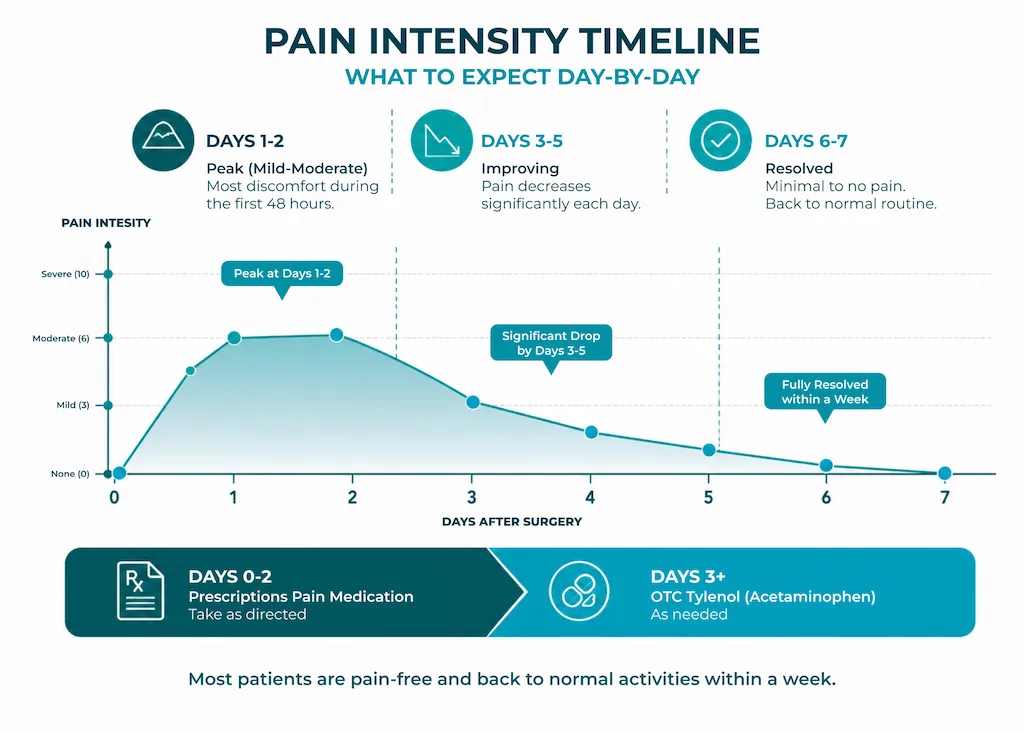
Fear of pain is one of the top reasons patients hesitate, and that is completely understandable. The reassuring reality is that otoplasty pain is manageable and temporary.
During the procedure itself, you won’t feel a thing. Otoplasty is performed with anesthesia to keep you comfortable during the procedure. Your surgeon will discuss the anesthesia options and any associated risks with you beforehand, so you can feel as safe and relaxed as possible during surgery.
Post-operative pain is typically described as mild to moderate soreness, aching, or throbbing around the ears. It peaks in the first 24 to 48 hours and subsides significantly by day three to five. Most patients transition from prescription pain medication to over-the-counter acetaminophen (like Tylenol) within a week.
The protective headband worn after surgery also helps more than you’d expect. It applies gentle compression that supports the ears and provides surprising comfort during the early healing days.
Your surgical team will note that otoplasty patients typically experience far less pain than many other facial procedures. Detailed post-operative care instructions and pain management guidance are provided so you know exactly what to expect at each stage of recovery.

What Is Otoplasty Overcorrection and How Is It Prevented?
Overcorrection is one of the most feared otoplasty complications, even though it is one of the least common. It occurs when the ears are pinned too close to the head, creating a “telephone ear” appearance where the outer rim is no longer visible from the front, and it happens in roughly 1 to 2% of cases.
But here is the thing. Ears often appear overcorrected immediately after surgery because of swelling and bandage compression. Most ears naturally relax two to three millimeters outward over the first three to six months, settling into their final position.
True overcorrection that persists beyond six months is uncommon. When it does happen, it is typically caused by overtight sutures, excessive cartilage removal, or failure to address specific anatomical factors during the initial procedure. A revision can usually restore a natural contour.
Prevention comes down to surgeon experience. A skilled surgeon accounts for the natural relaxation of cartilage over time, uses conservative suture tension, and evaluates both ears together for symmetry throughout the procedure. Knowing what overcorrection looks like is helpful, but knowing what warning signs to watch for during your overall recovery is equally important.
What Are the Warning Signs of Complications After Ear Pinning?
After otoplasty, it is important to know the difference between normal healing and signs that something needs attention. Some post-surgical symptoms look alarming but are completely expected.
Normal healing includes mild swelling that peaks in the first week, bruising that fades within 10 to 14 days, temporary numbness or tingling, and light drainage on the dressing. Most swelling resolves within two to four weeks, though subtle residual swelling can take six to eight weeks to fully disappear.
Contact your surgeon right away if you notice any of these warning signs:
- Sudden, severe pain on one side, which may indicate a hematoma (a blood pocket under the skin) requiring drainage.
- Fever above 101°F or chills in the days following surgery, which could signal infection.
- Increasing redness, warmth, or skin that feels hot around the incision.
- Foul-smelling or discolored drainage from the incision site.
- One ear becoming significantly more swollen than the other after the first 48 hours.
- Pain that worsens rather than improves, or returns after initially subsiding.
- Darkened or blackened skin near the ear, which could indicate compromised blood supply (meaning the area is not getting enough blood flow and needs immediate attention).
When in doubt, calling your surgeon is always the right move. Catching complications early makes them far easier to treat, and recognizing red flags is only part of the equation. The best strategy is reducing your chances of encountering them in the first place.
How Can You Reduce Your Risk Before and After Otoplasty?
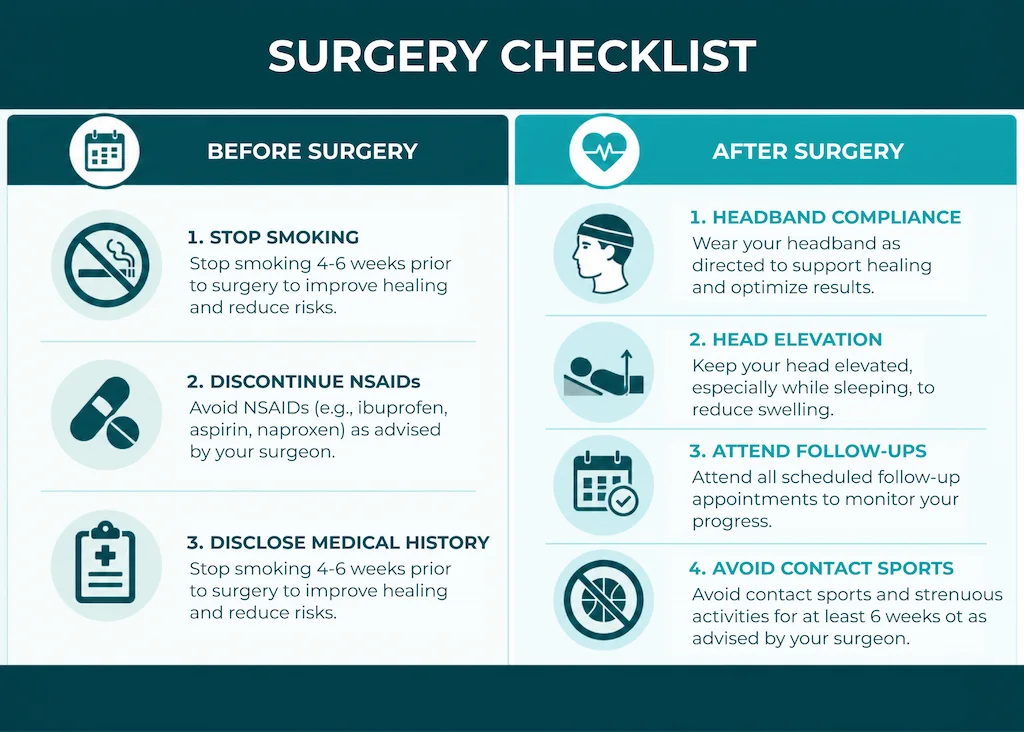
Here is something that might surprise you: you have more control over your outcome than you think. The choices you make before and after surgery directly influence your risk of complications.
Before surgery, stop smoking at least four to six weeks in advance, since smoking impairs blood flow and increases the risk of infection, poor healing, and skin necrosis. Discontinue aspirin, NSAIDs (like ibuprofen), and herbal supplements that can increase bleeding risk. Always disclose your complete medical history, including any history of keloid scarring.
After surgery, compliance with your care instructions is everything. Wear the protective headband exactly as directed, typically around the clock for two weeks, then at night for two additional weeks. Sleep with your head elevated and avoid sleeping on your side to prevent pressure on healing ears.
- Avoid contact sports and strenuous physical activity for at least six weeks.
- Attend all scheduled follow-up appointments so your surgeon can monitor healing and address any early concerns.
- Keep incision sites clean and dry, and avoid submerging your ears in pools or baths until cleared.
This commitment to thorough screening and preparation is central to the culture at Aesthetic Arts Surgical Arts.
Kortneigh shared her experience with the practice’s honest, personalized approach:
“From the very beginning, Dr. K impressed me with his honest, straightforward approach. He doesn’t sugarcoat things — he tells you what you need to hear to ensure not just good results, but great, safe, lasting ones. He takes BMI, smoking status, and overall health seriously, which gave me even more confidence in this practice.”
What Should You Look for When Choosing an Ear Pinning Surgeon?
Choosing the right surgeon is the single most impactful decision you will make in this process. Vague advice like “find a good surgeon” isn’t helpful, so let’s get specific about what to look for.
Board certification matters. Look for certification from the American Board of Cosmetic Surgery, the American Board of Plastic Surgery, or the American Board of Facial Plastic and Reconstructive Surgery. These boards require rigorous training, examination, and continuing education specific to cosmetic procedures.
Facility accreditation matters just as much as your surgeon’s credentials. Look for surgery performed in a facility accredited by organizations like AAAHC or AAAASF, these accreditations aren’t just badges on a wall. They mean the facility is regularly inspected and held to the same safety, staffing, and equipment standards as a hospital.
And when it comes to your surgeon, experience with otoplasty specifically makes a real difference, surgeons who perform ear pinning regularly simply tend to get more consistent, symmetrical results with fewer do-overs.
During your consultation, ask to see before and after photos of the surgeon’s own otoplasty patients, including real ear pinning results from people with concerns like yours, and ask about their complication and revision rates. Pay attention to whether they discuss risks openly and set realistic expectations. A surgeon who welcomes hard questions is a surgeon you can trust.
Dr. Michael Kluska, DO, FAACS, FACOS, is triple board-certified in Cosmetic Surgery, Plastic and Reconstructive Surgery, and General Surgery. A former President of the American Academy of Cosmetic Surgery and Master Surgeon designee, he brings Cleveland Clinic training and over 25 years of experience to every procedure at Aesthetic Arts Surgical Arts. Ear pinning surgery is performed in the practice’s AAAHC-accredited surgical center in Commerce, with consultation offices also available in Buford and Monroe.
Is Otoplasty Permanent or Can Your Ears Go Back?
In the majority of cases, otoplasty results are permanent. Once the cartilage has been reshaped, sutured into its new position, and reinforced by scar tissue during healing, your ears typically maintain their improved position for life.
That said, ear cartilage does have natural elastic memory (think of it like a rubber band that wants to return to its original shape). Clinical studies report recurrence rates ranging from roughly 2.8% to 13%, depending on the surgical technique used and how long patients are followed after surgery. The degree of return can range from barely noticeable to significant enough to warrant revision.
Factors that increase recurrence risk include use of dissolvable sutures instead of permanent ones, techniques that rely solely on sutures without cartilage reshaping, and not wearing the protective headband as directed during recovery. If significant recurrence does happen, a revision otoplasty can typically correct it. Because technique choice has so much influence on how long results last, ear reshaping surgery is a decision worth discussing in depth with your surgeon before moving forward.
During your consultation, your surgeon evaluates your ear cartilage characteristics and discusses the specific techniques recommended for your anatomy, selecting the approach that provides the most durable, natural-looking result for your individual situation.
Your Consultation & Next Steps
A consultation isn’t just about getting information. It is about having an honest, two-way conversation with someone who genuinely cares about your outcome.
Dr. Kluska will examine your ears, discuss your goals, review your medical history including any scarring tendencies, and give you a straightforward assessment of what otoplasty can realistically achieve. You will also get a personalized risk assessment based on your skin type, cartilage thickness, health history, and lifestyle factors.
Tiffany described her consultation experience:
“I had a consultation today for something I’ve felt very insecure about, and I was extremely nervous walking in. From the moment I met the doctor and nurse, their kindness and professionalism put me at ease. The doctor spoke to me with such calmness and compassion, even sitting beside me as he explained his thoughts and recommendations…”
Bring your list of questions, whether they are about pain, scarring, recovery, or anything else on your mind. A surgeon who welcomes your questions and answers them transparently is one you can trust with your care.
Ready to have an honest conversation about your ears? Call us at (706) 335-3555, schedule online, or view real patient results in our before-and-after gallery.
Conclusion
Otoplasty is one of the safest and most satisfying cosmetic procedures available today. With a 97% satisfaction rate and serious complications occurring in fewer than 5% of cases, the numbers speak for themselves. Yes, risks like scarring, pain, and infection exist, but they are well understood, mostly minor, and largely preventable when you choose the right surgeon and follow your post-operative care instructions carefully.
The bottom line is simple: the procedure itself is not what puts patients at risk. What makes the biggest difference is who performs it and where. A board-certified surgeon operating in an accredited facility, with real experience in otoplasty specifically, is the single most important factor in getting a safe, natural-looking, lasting result.
At Aesthetic Arts Surgical Arts in Georgia, that standard is the baseline, not the exception. If prominent ears have been on your mind, a consultation is the first step toward understanding your options and making a decision you feel genuinely confident about.
Frequently Asked Questions
How long do otoplasty scars take to fade completely?
Most ear pinning scars fade from red or pink to thin, barely visible lines within 6 to 12 months. Your final scar appearance depends on genetics, skin type, and how closely you follow your post-operative care instructions.
Can otoplasty cause permanent nerve damage or numbness?
Temporary numbness or tingling around the ears is common and usually resolves within a few weeks to months. Permanent nerve damage is extremely rare with experienced, board-certified surgeons. Nerves in this area are small sensory nerves, not motor nerves, so there is no risk of facial paralysis.
How common is it for ears to go back to their original position after otoplasty?
Recurrence rates range from roughly 3 to 13%, depending on the surgical technique and headband compliance during recovery. Significant recurrence requiring revision surgery is much less common, at about 2 to 5%.
Is otoplasty more painful for adults than for children?
Pain levels are similar regardless of age, though children typically receive general anesthesia while adults may have local anesthesia with sedation. Most patients of all ages describe the discomfort as mild and manageable with prescribed medication.
What happens if one ear heals differently than the other after surgery?
Mild asymmetry during healing is completely normal, as each ear recovers at its own pace. If noticeable asymmetry persists beyond six months, your surgeon can discuss whether a minor revision would be appropriate.
Can you get otoplasty if you have a history of keloid scars?
A history of keloids (raised, overgrown scars) doesn’t automatically disqualify you, but it does increase your risk of raised scarring. Your surgeon will evaluate your specific scarring history and may recommend strategies like steroid injections to manage this risk.