
You’ve been reading comparison charts for a week now. Silicone feels softer, saline costs less, and every site seems to rank them differently depending on who wrote it. The more you read, the less certain you feel about which option actually makes sense for your body and your goals.
You’re not stuck. Breast augmentation is one of the most sought-after cosmetic procedures in the world. According to the ISAPS (International Society of Aesthetic Plastic Surgery) 2024 Global Survey, nearly 3.9 million breast procedures were performed worldwide that year alone. That means a lot of women have sat right where you are, weighing the same choices, and found their answer.
At Aesthetic Arts, one of the names patients turn to for natural looking cosmetic surgery results, triple board-certified surgeon Dr. Michael Kluska has helped patients navigate implant decisions for over 25 years, with fellowship training at the Cleveland Clinic Health System. This article breaks down each implant type, compares them side by side, walks through the safety considerations, and helps you figure out which option fits your anatomy and lifestyle.
Key Takeaways
- Saline implants are filled with sterile saltwater during surgery, cost less, and make ruptures immediately obvious, but they tend to feel firmer than silicone options.
- Silicone gel implants closely mimic the softness of natural breast tissue, which is why they remain the most popular choice worldwide. They come in two forms: standard responsive gel, and form-stable “gummy bear” gel.
- Gummy bear is a subtype of silicone. It uses a highly cohesive gel that holds a teardrop shape even if the shell breaks, though it requires a slightly longer incision.
- No implant is permanent. Both saline and silicone implants last 10 to 20 years on average and may eventually need replacement.
- Your implant choice depends on your tissue coverage, aesthetic goals, and comfort level with monitoring, which is exactly what an in-person consultation is designed to sort out.
What Are Saline Breast Implants Like?
Saline implants have been around the longest, and they still hold a meaningful place in breast augmentation. Think of them like a water balloon inside a silicone shell: the outer shell goes in empty and is filled with sterile saltwater, the same saline used in hospital IV drips, once it’s in position.
That fill-after-placement design has a practical upside: your surgeon can use a smaller incision. It also allows for minor volume adjustments on the spot to help balance any natural asymmetry between your left and right sides.
The tradeoff is how they feel. Saline implants tend to be firmer and more uniform than silicone. In patients with less natural breast tissue, you may notice visible rippling, like a water-filled bag shifting under thin fabric. Placing the implant beneath the chest muscle (rather than on top of it) significantly reduces this. The FDA approves saline implants for augmentation in women 18 and older.
If a saline implant ruptures, there’s no mystery about it. Your body absorbs the saltwater harmlessly, but the breast deflates visibly, often within hours. You’ll know right away that a replacement is needed. Over a 13-year period, one study found a deflation rate of 8.3%, with overall patient satisfaction still reaching 93%.
| Pros | Cons |
| Smaller incision (inserted empty) | Firmer feel than silicone |
| Volume adjustable during surgery | Visible rippling with less tissue coverage |
| Rupture is immediately detectable | Deflation requires replacement surgery |
| Lower upfront cost | Less natural movement |
| FDA approved at age 18 for augmentation | May feel less like natural breast tissue |
So what does all that add up to? Saline is the straightforward, no-surprises option. Now let’s see where silicone picks up.
How Do Silicone Breast Implants Work?
Silicone implants come pre-filled with a cohesive silicone gel, similar to a thick, slow‑moving honey inside a sealed shell. That gel closely mimics the density and give of natural breast tissue, which is the main reason most patients describe silicone as the more natural-feeling option. In fact, silicone accounts for roughly 88% of breast augmentations worldwide.
The gel is a cross-linked polymer that shifts and responds to gravity much like your own tissue does. For patients with less natural coverage, silicone’s softer profile means significantly less visible rippling compared to saline. Dr. Kluska evaluates each patient’s tissue thickness to determine which implant material will produce the most natural result. You can learn more about his approach on the Dr. Kluska page.
Silicone does come with one tradeoff worth understanding. If the shell develops a tear, the gel tends to stay contained rather than leaking out visibly. This is called a “silent rupture”, you may not notice any change in appearance or feel. That’s why the FDA recommends getting an MRI or ultrasound starting five to six years after surgery, then every two to three years after that.
Here’s what that means practically: choosing silicone means budgeting for periodic imaging down the road. That’s a reasonable trade-off for many patients, especially given that many clinical studies report satisfaction rates above 80% over multiple years.
- Gel that moves like natural tissue, reducing the “implant look”
- Less visible rippling, even with limited tissue coverage
- Pre-filled, so the incision is slightly longer than saline
- Silent ruptures require MRI or ultrasound screening
- FDA approved for augmentation at age 22 and older
- High patient satisfaction reported through up to six years of follow-up
If you’re weighing whether silicone’s natural feel is the right fit for your goals, schedule a consultation to discuss your options in a comfortable, no-pressure setting.
Form-Stable (“Gummy Bear”) Silicone: A Subtype Worth Knowing
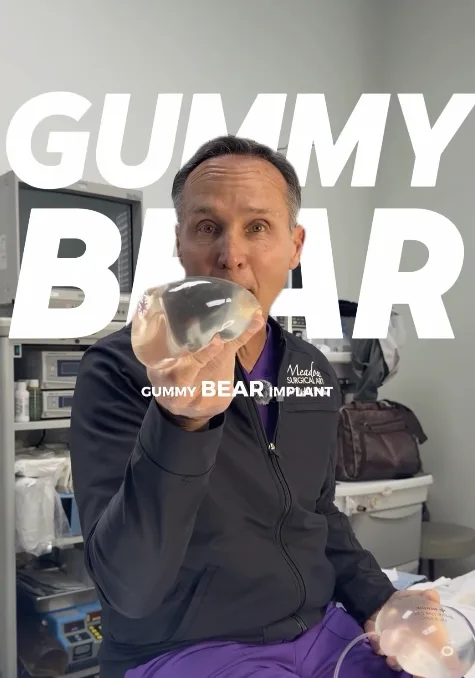
Within the silicone family, form-stable implants nicknamed “gummy bear”, use a more highly cohesive gel than standard silicone. The shell and fill are still silicone; what’s different is how firm the gel is.
The name comes from exactly what you’d guess: cut one in half and the gel holds its shape, just like the candy. The technical term is “form-stable,” meaning the gel maintains a teardrop contour even under pressure or if the shell were to break.
Dr. Kluska describes the practical difference this way: a highly cohesive gel can be gently moved and reshaped by hand, yet it always springs back to its original form, which is what gives these implants their stable, predictable contour. He also points to a safety upside of that cohesivity. Because the gel holds together as a single piece, a highly cohesive implant, such as the Allergan Natrelle® and Motiva® options, is designed to stay contained rather than disperse into the surrounding lymphatic channels if the shell is ever damaged.
Standard silicone shifts with gravity and body position, which creates a natural, fluid look. Gummy bear gel does the same to a lesser degree, but it prioritizes consistent shape over maximum softness. Think of it as the difference between a water pillow and a memory foam pillow: both comfortable, but one holds its shape better.
That shape retention comes with a lower rate of capsular contracture (more on that below). One study found a capsular contracture rate of 4.1% at six years with form-stable implants.
Because the gel is stiffer and can’t be squeezed through a small opening, gummy bear implants require a slightly longer incision, typically 4.5 to 5.5 centimeters, placed along the inframammary fold (the natural crease beneath the breast). This placement keeps the scar well-hidden.
At Aesthetic Arts, every implant decision is tailored to your body size, shape, and existing tissue. The goal is always a result that looks and feels like it belongs.
Bailey, an Aesthetic Arts patient who chose breast implant surgery after a thorough consultation, shared:
“I recently had breast implant surgery with Dr. Kluska, and I couldn’t be happier with the results. From the very first consultation, I felt completely at ease. Dr. Kluska took the time to listen to my goals, answer all of my questions, and explain every step of the process.”
There is one consideration unique to gummy bear implants worth discussing with your surgeon. Because many are teardrop-shaped, if the implant rotates inside the pocket, it can distort the breast’s contour. The rotation risk sits around one to 2%, and textured surfaces help the implant grip surrounding tissue to stay in place.
So… which one is right for you? With saline and silicone (including form-stable “gummy bear” options) available, the best choice depends on what matters most for your body and goals.
How Do Saline and Silicone Breast Implants Compare?

Choosing between implant types gets easier when you can see the differences in one place. Each option has clear strengths, and the right one depends on what matters most to you.
| Feature | Saline | Silicone (incl. Gummy Bear) |
| Fill material | Sterile saltwater | Cohesive silicone gel |
| Feel | Firmer, less natural | Soft, mimics breast tissue |
| Rupture detection | Visible deflation | Silent; requires imaging |
| Incision size | Smallest (inserted empty) | Medium to slightly longer (pre-filled) |
| Rippling risk | Higher with less tissue | Lower |
| FDA age (augmentation) | 18+ | 22+ |
| Average lifespan | 10 to 20 years | 10 to 20 years |
| Relative cost | Most affordable | Mid-range to higher |
Note: “Gummy bear” implants fall under the silicone column. They share silicone’s rupture-detection profile, FDA age minimum (22+), and imaging requirements. Where they differ from standard silicone: slightly firmer feel, better shape retention, lower rippling risk, and a slightly longer incision.
The feel difference is the factor most patients notice first. Silicone implants, both standard gel and form-stable gummy bear, mimic natural tissue more closely than saline, which tends to feel uniform and slightly firm. If maximally soft, natural movement is a priority, standard silicone gel often wins that comparison. If shape retention is the priority, the form-stable gummy bear option within silicone is built for that.
Rupture detection is where saline has a clear advantage. A saline rupture deflates visibly within hours, and the body absorbs the saltwater without harm. Silicone ruptures, whether standard gel or gummy bear, are often “silent,” with the FDA recommending routine MRI or ultrasound screening starting five to six years after surgery.
On longevity, both saline and silicone implants last 10 to 20 years on average. None are lifetime devices. Within silicone, form-stable (gummy bear) gel tends to sit at the higher end of that range because it resists wear differently than standard silicone gel.
At Aesthetic Arts, the implant conversation always happens in person, with your anatomy and goals guiding every recommendation. There is no single best implant type, only the best one for you.
Mckenzie H., an Aesthetic Arts patient who valued the full journey from consultation to post-surgery care, shared their experience:
“I had breast implants put in back in march, and I could have asked for a better experience. From the consultation to the pre-op appointment to surgery day and post surgery care the whole thing was just great. I was so nervous the day of surgery, and Dr. M… the whole thing was just great.”
To help make your goals more accessible, we offer flexible financing through Cherry Credit and CareCredit, so you can choose a payment plan that fits your budget.
Feeling good about the comparison is one thing. Understanding the safety picture is what lets you move forward with real confidence.

What Safety Risks Come With Breast Implants?
Every surgical procedure carries some degree of risk, and breast implants are no exception. The good news is that decades of data and ongoing FDA monitoring have made the safety profile well understood. Knowing what to watch for puts you in control.
Capsular Contracture
After any implant is placed, your body naturally forms a thin layer of scar tissue around it, that’s completely normal, like how a callus forms around a splinter. Capsular contracture happens when that tissue tightens and squeezes the implant, causing firmness, discomfort, or a change in shape.
Rates vary by implant surface type. Studies consistently show textured implants have lower capsular contracture rates compared to smooth implants. If it does develop, your surgeon can address it with a revision procedure. Catching it early makes the correction more straightforward.
Implant Rupture
Rupture risk increases the longer an implant is in place, which is one reason none are considered lifetime devices. For saline, the rupture is obvious. For silicone (both standard gel and gummy bear), the gel typically stays contained inside the scar tissue capsule, called an intracapsular rupture. The FDA notes that silicone breast implants can rupture at any time, with risk increasing the longer they are in place. Many ruptures are ‘silent’ and may only be detected through imaging such as MRI or ultrasound
BIA-ALCL (Breast Implant-Associated Lymphoma)
Breast implant-associated anaplastic large cell lymphoma (BIA-ALCL) is a rare type of immune system cancer found in the scar tissue or fluid surrounding textured implants, not in the breast tissue itself. It is not breast cancer. The risk ranges from roughly one in 355 to one in 30,000 depending on the implant surface type. It typically develops years after surgery and often shows up as swelling or a fluid collection around the implant.
When caught early, it’s highly treatable by removing the implant and surrounding capsule. Smooth-surfaced implants carry a significantly lower risk. It’s a serious topic worth discussing with your surgeon when choosing an implant surface.
Breast Implant Illness (BII)
Some patients report persistent symptoms such as fatigue, joint pain, brain fog, and skin changes that they associate with their implants. This is commonly referred to as breast implant illness (BII). While the FDA has not established a direct causal link, ongoing research has identified a range of systemic symptoms reported by some breast implant patients, and the relationship continues to be studied.
If you experience unexplained symptoms after augmentation, discuss them with your surgeon. Explant surgery (removing the implants entirely) resolves symptoms for many patients who choose that path.
Monitoring and Imaging
For silicone implants (including the form-stable gummy bear subtype), the FDA recommends an MRI or ultrasound at five to six years post-surgery, then every two to three years after that. Saline ruptures don’t need imaging because they’re immediately visible. Keeping up with your screening schedule is the simplest way to stay ahead of any potential issues.
Here’s the good news. Knowing the safety landscape puts you in control, and it clears the path to the most personal part of the decision: which implant actually fits your life.
How Do You Choose the Right Breast Implant?
The answer isn’t hiding in another comparison chart, though everything to know before your breast augmentation is a helpful place to start. It’s in a conversation about your body, your goals, and what matters most to you over the next 10 to 20 years.
Your natural tissue coverage is the starting point. Patients with more breast tissue have flexibility across both implant categories. Those with less coverage tend to benefit from silicone (either standard gel or form-stable gummy bear) because they’re less likely to show visible edges or rippling.
Lifestyle plays a role too. Within silicone, the choice is between responsiveness and shape retention. If you want an implant that holds its projection through movement and gravity changes, the form-stable gummy bear variety is built for that. If soft, natural movement is the priority, standard silicone gel is often the better match. And if you prefer avoiding periodic MRI screenings, saline’s obvious rupture detection removes that ongoing commitment.
Then there’s shape, profile, and placement, decisions that can only be made with a hands-on evaluation. This is where an in-person consultation fills the gaps that no article can.
At Aesthetic Arts, your consultation is a two-way evaluation. It’s your chance to assess the practice and surgeon just as much as it’s an opportunity for your anatomy to be evaluated against your goals. The preoperative assessment includes a determination of desired breast size and shape, with every decision factored against your body’s proportions and existing tissue.
All procedures involving silicone and saline implant options are performed at the AAAHC-accredited surgical facility in Commerce, Georgia, under general anesthesia. Consultations are available at all three Georgia offices: Commerce, Buford, and Monroe.
Kortneigh M., an Aesthetic Arts patient who spent years researching before choosing her surgeon, described their experience:
“After years of consideration, research, and weighing my options, I’m officially just 18 days away from my breast augmentation surgery + lift and I couldn’t be more confident in my decision to go with Dr. Kluska! From the very beginning, Dr. K impressed me with his honest, straightforward approach.”
To help make your goals more accessible, financing through Cherry Credit and CareCredit lets you choose a payment plan that fits your budget, with 0% APR options available through Cherry Credit.
Request an appointment at any of our three Georgia locations, or call (706) 335-3555 (Commerce) or (678) 541-0339 (Buford) to get started.
Conclusion
Choosing breast implants isn’t about memorizing specs, it’s about finding the option that feels right for you. You began this journey sorting through charts and conflicting opinions, but now you have a clear picture of how saline and silicone compare, what the safety data says, and what real patient experiences look like.
The next step is personal: browsing before‑and‑after photos that match your starting point, and sitting down for a consultation where your anatomy and goals guide the decision. Seeing what real breast augmentation transformations look like helps set expectations before that conversation. That’s where the details that charts can’t capture come to life.
At Aesthetic Arts, Dr. Kluska and our team believe every patient deserves to feel heard, respected, and confident in their choices. Beyond breast augmentation, our practice also offers non-surgical care including cosmetic injectable procedures, dermal fillers, and a medically supervised weight loss program, along with spa treatments such as Diamond Glow facials, dermaplaning, and microdermabrasion to support your aesthetic goals well past surgery. Your story doesn’t end with research, it begins with a conversation.
Ready to take the next step? Schedule your consultation today, or call Commerce: (706) 335‑3555 or Buford: (678) 541‑0339. We can’t wait to meet you and help you find the option that truly fits your life.
Whether you’re exploring surgery for cosmetic needs in Commerce, GA, or considering Buford cosmetic surgery, a personalized consultation can help you understand your options and choose an approach that aligns with your aesthetic goals.
Frequently Asked Questions
Which breast implant feels most natural?
Silicone gel implants are widely considered the most natural-feeling option because the gel closely mimics the density and movement of breast tissue. Within silicone, standard responsive gel feels softest, while form-stable gummy bear gel is slightly firmer in exchange for better shape retention.
Are form-stable (gummy bear) silicone implants safer than saline?
Both have strong safety profiles, they just handle risk differently. Gummy bear silicone shows lower capsular contracture rates and less visible rippling, while saline offers the advantage of immediately obvious rupture detection.
What happens if my implant ruptures?
A saline implant deflates visibly within hours as your body absorbs the harmless saltwater. Silicone ruptures, whether standard gel or form-stable gummy bear, are often silent, with the gel staying inside the scar tissue capsule. That’s why the FDA recommends routine imaging for silicone implants.
Can I breastfeed with implants?
Most patients can breastfeed successfully with implants. Incision location and implant placement can influence milk supply, so discuss your plans with your surgeon if breastfeeding is a future priority.
How much do different breast implants cost?
Saline implants are the most affordable; form-stable (gummy bear) silicone typically cost the most within the silicone category. Total procedure costs depend on surgical technique, anesthesia, and facility fees. An in-person consultation is the most accurate way to get pricing specific to your goals.
What is the FDA minimum age for breast implants?
Saline implants are FDA-approved for augmentation starting at age 18. All silicone implants, both standard gel and form-stable gummy bear, require you to be at least 22 for augmentation. All types are approved at any age for breast reconstruction.
Do silicone implants need MRI checks?
Yes. The FDA recommends an MRI or ultrasound at five to six years after surgery, then every two to three years after that, to screen for silent ruptures. This applies to both standard silicone and gummy bear implants.
Which implant type has the least rippling?
Form-stable (gummy bear) silicone implants have the lowest rippling rates because the highly cohesive gel holds its shape. Standard silicone also ripples less than saline, making both silicone options stronger choices for patients with limited tissue coverage.
How long do breast implants last?
Both saline and silicone implants last 10 to 20 years on average. They are not lifetime devices, and the likelihood of needing a replacement or revision increases over time.
Do breast implants affect mammograms?
Yes, implants can obscure some breast tissue on mammography. Specialized displacement views help technicians work around them. Patients at Aesthetic Arts are encouraged to inform their imaging center about their implants so the appropriate technique is used.
Which incision type works best for each implant?
Saline implants use the smallest incision because they’re filled after insertion. Silicone implants are pre-filled and typically require a slightly longer inframammary fold incision (beneath the breast crease). Form-stable gummy bear silicone usually requires the longest incision, 4.5 to 5.5 cm because the firmer gel can’t be compressed through a small opening.
*Disclaimer: This content is for educational purposes only and does not constitute medical advice. A consultation with a qualified board-certified surgeon is required to determine the best treatment plan for your individual needs and any questions you may have about a medical condition or procedure.

Written & medically reviewed by
Dr. Michael Kluska
Triple Board-Certified Cosmetic & Plastic Surgeon | Founder of Aesthetic Arts
Dr. Michael Kluska is triple board-certified in cosmetic, plastic and reconstructive, and general surgery, with over 25 years in practice specializing in full-face and body cosmetic surgery. As a past president of the American Academy of Cosmetic Surgery and an adjunct clinical professor of plastic surgery at the Philadelphia College of Osteopathic Medicine, he brings published, peer-reviewed expertise to every procedure at Aesthetic Arts.