

You searched “otoplasty cost” and got numbers ranging from $2,000 to $10,000. That’s not helpful, that’s a headache. If you’re seriously considering ear pinning surgery, you deserve actual numbers, not a range wide enough to drive a truck through. If you’re still weighing whether surgery is the right path, it helps to first understand the full range of surgical and non-surgical solutions for ears that stick out.
The American Society of Plastic Surgeons reports an average surgeon fee range between $4,500-7,500, but that’s the surgeon fee only, and it doesn’t tell the whole story. Anesthesia, facility fees, and post-op care can push the real total significantly higher. Knowing what’s actually included in any quote you receive makes all the difference.
At Aesthetic Arts Surgical Arts, our surgeon brings triple board certification, 20+ years of surgical experience, and Cleveland Clinic training to every consultation. This guide covers the national average cost, what drives price differences by region and technique, and how to decide whether the investment makes sense for you.
5 Things You Should Know About Otoplasty Costs
- The national average cost of otoplasty is $3,981, and Georgia comes in below average at $3,478, making it one of the more affordable states for ear surgery.
- The total out-of-pocket range runs $3,000 to $8,500 when you factor in anesthesia, facility fees, and aftercare, not just the surgeon’s fee.
- Board-certified surgeons typically charge 15 to 30% more than non-certified providers, but peer-reviewed data links board certification to lower complication rates and better outcomes.
- Insurance rarely covers otoplasty because it’s considered cosmetic. However, a 2021 study found that 43% of insurance policies include some ear-related coverage when a medical necessity exists.
- Financing through CareCredit and Cherry Credit makes ear pinning accessible for most budgets, and with a 90.7% “Worth It” rating from real patients, most people don’t regret the spend.
How Much Does Ear Pinning Surgery Cost on Average?
The most-cited national average for otoplasty is $3,981, based on 2024 data from Synchrony/CareCredit. But that figure represents the surgeon’s fee in most cases, it doesn’t include the full picture of what you’ll actually pay. The ASPS puts the average surgeon fee even higher at $4,625, reflecting the premium practices in larger metro areas that skew national averages upward.
When you add in anesthesia, surgical facility fees, pre-op labs, and post-op care, the realistic total runs $3,000 to $8,500. Bilateral otoplasty (both ears) typically falls between $3,500 and $6,000. Unilateral procedures, correcting just one ear, generally cost less, though the savings aren’t always proportional since facility and anesthesia fees are largely fixed.
Here’s the good news: the lower end of that range is very real in states like Georgia. Understanding which components make up the total helps you compare quotes accurately and avoid apples-to-oranges confusion.
| Cost Component | Typical Range | Notes |
|---|---|---|
| Surgeon’s Fee | $2,000 – $5,500 | Varies by board certification, experience, and location |
| Anesthesia Fee | $500 – $1,200 | General anesthesia costs more than local with sedation |
| Surgical Facility Fee | $600 – $1,800 | Accredited outpatient centers are typically less than hospitals |
| Pre-op Labs & Tests | $150 – $400 | Blood work, EKG if needed; sometimes included in consultation |
| Post-op Medications | $50 – $200 | Prescription pain relievers, antibiotics, ear drops |
| Compression Headband | $30 – $100 | Worn for several weeks post-surgery; some practices provide it |
| Follow-up Visits | $0 – $300 | Many surgeons include follow-ups; confirm before signing |
What Factors Affect the Cost of Otoplasty?
No two otoplasty quotes look exactly alike, and that’s not a red flag, it’s just reality. Several variables combine to determine your final price, and understanding them helps you evaluate quotes intelligently rather than just hunting for the lowest number.
A lot of people worry that a higher price means a surgeon is overcharging, or that a lower price means something is being cut. Sometimes those instincts are right. But more often, price differences come down to three main factors: who’s doing the surgery, where it’s being done, and how complex your case is.
Surgeon Experience and Board Certification

Surgeon credentials account for 50 to 70% of the total costs. Board-certified surgeons typically charge 15 to 30% more than non-certified providers. That premium reflects years of additional training, a demonstrated safety record, and accountability to a certifying board.
Dr. Kluska’s triple board certification in Cosmetic Surgery, Plastic and Reconstructive Surgery, and General Surgery puts him in a rare category among surgeons in Georgia. Procedures at Aesthetic Arts Surgical Arts are performed at an AAAHC-accredited surgical center in Commerce, a credential that reflects rigorous safety and quality standards.
Amber, a patient at the Commerce location, put it this way:
“Dr Kluska is an incredible artist, magician and plastic surgeon all wrapped into one! He has the BEST bedside manner, always makes sure the patient is 110% comfortable with everything and makes what feels like the impossible sound/look totally simple. He has made me feel great in my own skin again.”
That kind of experience doesn’t happen by accident. It’s the result of surgeon skill and a practice culture that prioritizes patient comfort alongside clinical outcomes.
Geographic Location
Where you have surgery matters a lot. Urban markets like Manhattan, Los Angeles, and Boston carry overhead costs that get passed along to patients. In contrast, Georgia’s average cost for surgical correction of ear shape sits at $3,478, which is well below the national average of $3,981.
The Southeast broadly offers competitive pricing without the quality gap some patients fear. You’re not sacrificing expertise by staying close to home, you may actually be getting more for less.
Anesthesia, Facility, and Complexity
General anesthesia runs $500 to $1,200 more than local anesthesia with sedation, and some cases genuinely require it. Surgical facility type also affects cost, hospital operating rooms are typically more expensive than accredited outpatient centers. Bilateral procedures cost more than unilateral, and revision surgeries (correcting a previous otoplasty) are almost always more complex and priced accordingly.

How Do Otoplasty Costs Vary by Region and State?
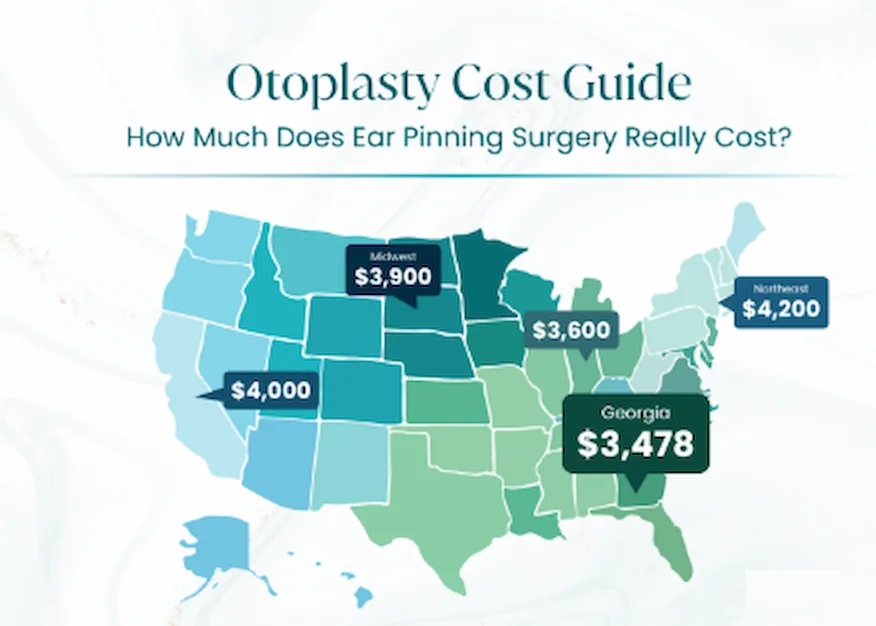
Geography is one of the biggest cost levers in plastic surgery. Georgia’s average of $3,478 compares favorably to neighboring states and national figures, making the Southeast a practical choice for patients across the region.
Looking at neighboring states: Alabama averages $3,491, Tennessee $3,593, South Carolina $3,691, and North Carolina $3,678. Florida comes in higher at $4,003. At the top end of the national spectrum, Hawaii averages $5,500, Massachusetts $5,070, Washington D.C. $5,028, and California $4,985.
| Region | Average Cost Range | Key Price Factor |
|---|---|---|
| Georgia | $3,200 – $4,800 | Below national average; strong board-certified presence |
| Southeast (AL, TN, SC, NC) | $3,400 – $5,000 | Moderate overhead; competitive market |
| Florida | $3,500 – $5,500 | Tourism-driven premium in coastal metros |
| Northeast (MA, NY, CT) | $4,500 – $7,500 | High cost of living; major academic centers |
| West Coast (CA, WA, OR) | $4,500 – $7,000 | Urban premium; high real estate and labor costs |
| National Average | $3,000 – $8,500 | Full range including all cost components |
How Does the Surgical Technique Affect the Price?
Not all otoplasty procedures use the same approach, and technique differences have a real impact on both cost and outcome. There are three main categories: cartilage-sparing (suture-based), cartilage-scoring (incision-based), and combination techniques.
A systematic review published in the Journal of Craniofacial Surgery found that cartilage-sparing techniques produce better aesthetic outcomes with a complication rate of 4.27% for recurrence and 2.46% for suture erosion, markedly lower than cartilage-scoring alternatives.
Let’s break that down. Cartilage-scoring involves incisions that modify the ear structure more aggressively, which can increase operating time and recovery complexity. Suture-based approaches tend to be faster, involve less tissue disruption, and recover more predictably, factors that influence both the surgeon fee and anesthesia time.
| Technique | Cost Range | Procedure Time | Anesthesia | Best For |
|---|---|---|---|---|
| Cartilage-Sparing (Suture-Based) | $2,800 – $5,500 | 45 – 90 min | Local or general | Standard prominent ear correction; lower recurrence rate |
| Cartilage-Scoring (Incision-Based) | $3,200 – $6,500 | 60 – 120 min | General preferred | Severe deformity; stiff cartilage requiring reshaping |
| Combination Technique | $3,500 – $7,000 | 90 – 150 min | General | Complex asymmetry; cases requiring both reshaping and repositioning |
Does Insurance Cover Otoplasty Ear Surgery?
In most cases, otoplasty is classified as a cosmetic procedure, which means standard health insurance won’t cover it. That said, coverage isn’t impossible, a 2021 study presented to the Northeastern Society of Plastic Surgeons found that 43% of insurance policies analyzed included some form of ear-related coverage when a documented medical necessity existed.
Medically necessary cases, such as congenital ear deformity, trauma-related correction, or ear anomalies affecting hearing, have the strongest shot at partial coverage. The same NESPS study found that 80% of policies cover hearing loss correction, and 56% cover procedures to normalize ear position. Your surgeon can document medical necessity and submit a pre-authorization request on your behalf, it’s worth asking before assuming it won’t be covered.
If insurance denies the claim, you have the right to appeal. A strong appeal typically includes a letter of medical necessity from your surgeon, supporting medical records, and any relevant imaging. It’s extra paperwork, but approvals on appeal do happen.
How Does Recovery Time Impact the Total Cost of Otoplasty?
Recovery has a financial footprint that most cost guides skip entirely. Beyond the surgery bill, you’ll need to account for time away from work, post-op supplies, and the occasional follow-up visit. For patients who earn an hourly wage, even a short recovery has a real dollar value attached to it.
At $25 per hour, a full week of missed work equals roughly $1,000 in lost wages. Most patients return to desk work within 5 to 7 days, though physically demanding jobs may require two or more weeks off. Building this into your total budget from the start avoids cash flow stress during recovery.
- Week 1: Rest at home, headband worn continuously, minimal activity. Most patients are comfortable for light desk work by day 5-7.
- Weeks 2-4: Compression headband worn at night, light activity allowed, gradual return to normal routine. Swelling visible but manageable.
- Weeks 4-6: Most daily activities resumed, strenuous exercise cleared at surgeon’s discretion. Results increasingly visible as swelling resolves.
Post-op supplies, like compression headband, saline rinse, scar treatment, typically run $150 to $300 total. Many of these items can be found at a pharmacy for a fraction of specialty pricing, so ask your surgeon for a generic equivalent list.
Is Otoplasty Worth the Investment?
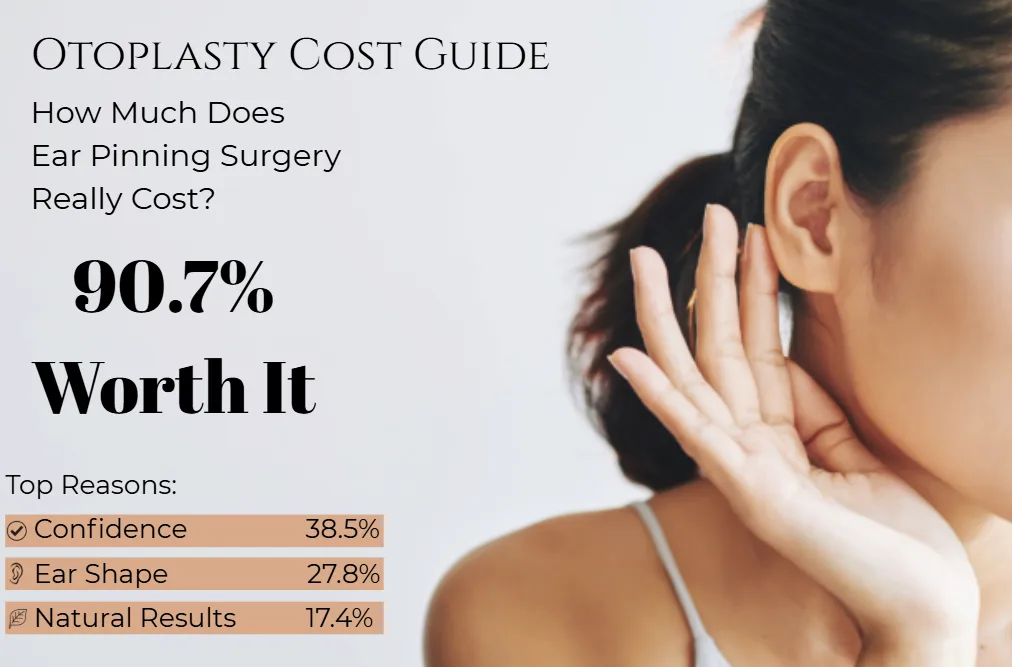
The data on patient satisfaction is striking. A peer-reviewed study analyzing RealSelf reviews from January 2009 through March 2025 found a 90.7% “Worth It” rating from 615 verified patient reviews, one of the highest satisfaction scores in elective cosmetic surgery.
What drove those high ratings? Improved confidence (38.5% of patients cited it as the primary benefit), enhanced ear shape (27.8%), and natural-looking results (17.4%). Notably, the study found that satisfaction was not associated with how much patients paid, it was strongly associated with minimal post-op pain and clear communication from the surgeon.
So what does that mean for you? The value of otoplasty isn’t primarily in a price point, it’s in finding a surgical team whose outcomes and communication style earn trust. Permanent results from a single procedure, combined with complication rates under 5% using cartilage-sparing techniques, make the math compelling for most patients who are good candidates.
At Aesthetic Arts Surgical Arts, over 20 years of surgical experience goes into every procedure, the kind of depth patients look for in aesthetic enhancement specialists. The surgical team’s results are documented in the practice gallery and the surgeon’s personal gallery at drdaddyk.com, both worth reviewing before your consultation.
Elizabeth, who has used multiple services at both the Commerce and Buford locations, shared her perspective on value:
“When looking at cosmetic procedures and price comparing, you will find that Aesthetic Arts is right in line with other Medspas. But what sets Dr Kluska apart is his INTEGRITY and true desire to give the best care and satisfaction to his patients. After my experience, I would not hesitate to recommend Aesthetic Arts to everyone!!!”
What Questions Should You Ask About Cost During Your Consultation?
A good consultation isn’t just about getting a number, it’s about understanding exactly what that number covers and what happens if things don’t go as planned. Come prepared with these 10 questions to make the most of your time.
- Is the quoted price all-inclusive, or will there be separate bills for anesthesia and the facility?
- What anesthesia approach do you recommend for my case, and how does it affect the total cost?
- Does the fee include all follow-up appointments, or are post-op visits billed separately?
- What is your policy on revision surgery, is there an additional fee if a touch-up is needed?
- Are pre-op lab work and consultation fees included, or are those separate charges?
- Which financing options do you accept, and can I apply before my surgery date?
- Do you offer any seasonal promotions or package pricing for combined procedures?
- Is there a payment schedule, or is the full amount due before surgery?
- What does your complication rate look like for this procedure, and how does that compare to published benchmarks?
- Can you walk me through a realistic recovery timeline and any associated costs I should plan for?
Your Consultation and Next Steps
At your consultation, Dr. Kluska will examine your ear anatomy, discuss your goals, and present a treatment plan with a fully itemized quote. It’s also the moment to ask every question on your list, no rushed decisions, no pressure.
But here’s the thing: the consultation experience itself tells you a lot about what surgery will be like. Pay attention to how you’re treated before you commit to anything.
Tiffany, who came in feeling nervous about her consultation, described what she found:
“I had a consultation today for something I’ve felt very insecure about, and I was extremely nervous walking in. From the moment I met the doctor and nurse, their kindness and professionalism put me at ease. The doctor spoke to me with such calmness and compassion, even sitting beside me as he explained his thoughts and recommendations. His humble demeanor, paired with his impressive expertise and triple board certification, truly sets him apart.”
Financing is available from day one, both CareCredit and Cherry Credit can be applied for before your surgery date, so you can lock in your plan and schedule your procedure without delay.
Conclusion
Otoplasty costs range from $3,000 to $8,500 depending on surgeon credentials, technique, location, and what’s included in the quote. Georgia comes in below the national average at $3,478, making it one of the more cost-accessible states for the procedure. Understanding the full picture, including hidden fees and recovery costs, is what turns an overwhelming research process into a clear, confident decision.
Ready to find out what ear surgery would cost for your specific case?
Call us at Commerce: (706) 335-3555 | Buford: (678) 541-0339 | or schedule online at your convenience.
Want to see real results before booking? Browse the Aesthetic Arts Surgical Arts gallery
Frequently Asked Questions
How much does otoplasty cost in Georgia?
Georgia’s average otoplasty cost is approximately $3,478, which is below the national average of $3,981. Total out-of-pocket costs, including anesthesia and facility fees, typically range from $3,000 to $6,500 depending on case complexity and surgeon credentials.
Is ear pinning surgery covered by health insurance?
In most cases, otoplasty is considered cosmetic and isn’t covered by health insurance. However, if a documented medical necessity exists, a 2021 study found that 43% of insurance policies include some form of coverage, so it’s worth asking your insurer before assuming you’re on your own.
What is the cheapest way to get otoplasty?
Choosing a board-certified surgeon in a cost-competitive region like Georgia, using an accredited outpatient center rather than a hospital, and financing through a 0% APR option, all reduce the effective cost of the procedure. Avoid the temptation to prioritize the lowest quote an under-qualified surgeon can create revision costs that far exceed the original savings.
Does otoplasty cost more for adults than children?
The surgical fee is generally similar for adults and children, but anesthesia considerations can vary. Children often require general anesthesia, which adds to the total, while some adult cases can be completed under local anesthesia with sedation at lower cost.
How much does it cost to pin back one ear vs. both ears?
Bilateral otoplasty (both ears) typically runs $3,500 to $6,000. Unilateral procedures cost less for the surgical portion, but facility and anesthesia fees remain largely fixed, so the savings aren’t always proportional.