
The Quick Answer
A guide to the deep plane facelift, which addresses the fear of looking “done” by releasing the facial retaining ligaments and repositioning skin, fat, and muscle as one unit so the skin drapes without tension. It compares the technique to SMAS and mini lifts on depth, recovery, and longevity (10 to 15 years versus 5 to 7), covers candidacy, a week-by-week recovery arc, risks, cost drivers, and how to vet a surgeon, pointing to Dr. Kluska at Aesthetic Arts in Commerce, Georgia.
There’s one fear behind almost every facelift search: ending up looking tight, pulled, or just not like yourself. You don’t want to look “done.” You want to look like you, just rested and matching how you actually feel.
The deep plane facelift was developed to answer that worry. Globally, 737,028 face lift procedures were performed in 2024, and a growing share of those used the deep plane technique because it works with your facial anatomy rather than pulling against it. The skin itself isn’t stretched tight. Instead, the underlying tissues are repositioned as a single unit so the surface drapes naturally over a refreshed foundation.
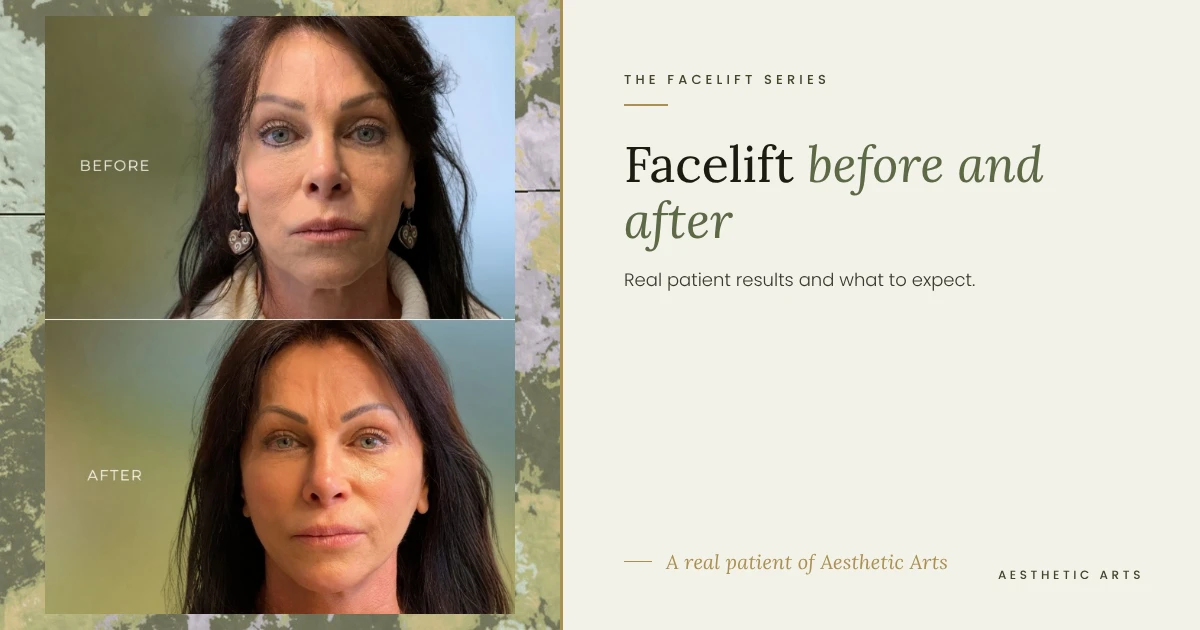
At Aesthetic Arts in Commerce, Georgia, the Face gallery includes deep plane facial rejuvenation patients photographed seven years after surgery, still looking like themselves. This article walks through how the deep plane technique works and how it compares to a SMAS or mini facelift. You’ll also learn what results and recovery to expect, who makes a good candidate, and what to look for in a surgeon.
Key takeaways
- The deep plane technique works in a deeper anatomical layer than a SMAS facelift, releasing the facial retaining ligaments so the soft tissues can be repositioned as a single composite flap with no tension on the skin.
- Results typically last 10 to 15 years, and extended deep plane techniques can last 12 to 15 years or more, far longer than a mini facelift’s 5 to 7 years.
- Recovery takes 2 to 3 weeks for social activities and 6 to 8 weeks for full physical activity, with final tissue settling at 3 to 6 months.
- The best candidates are usually in their 40s through 70s with good overall health, moderate to advanced facial aging, and a desire for results that look natural rather than stretched or pulled.
- Surgeon experience matters more than any other factor for a good outcome. Verify board certifications, ask how many deep plane cases the surgeon has performed, and review their before-and-after gallery in person.
How is a deep plane facelift performed?

A deep plane facelift works in a deeper layer of your face than most people realize exists. Instead of pulling the skin tighter, which is what older facelift techniques did, your surgeon lifts the muscle and tissue underneath and moves them back to where they used to sit. The skin isn’t stretched at all. It just drapes naturally over a foundation that’s been reset. That’s why the results look like you, not like you had surgery.
Releasing the anchors
Your face has a network of small ligaments (think of them as tiny tethers) that hold the skin and soft tissue down against the bone and muscle underneath. When you’re young, those tethers keep everything in place. As you age, the tissue around them sags, but the tethers themselves hold firm. That’s what creates the pulling-down effect you see in jowls and deep nasolabial folds.
During a deep plane facelift, your surgeon carefully releases those tethers. Once they’re freed, the midface and lower face can move upward together as one piece, smoothly, instead of being held back at fixed points.
Lifting everything together
Once those anchors are released, your surgeon lifts the entire layer, skin, fat, and muscle, up and slightly outward, back toward where it all used to sit. That whole piece moves as one connected unit.
It’s then secured to stable structures deeper in the face with sutures. The skin drapes over that repositioned foundation with almost no tension. That’s the key detail. When skin isn’t being pulled tight, the result looks natural instead of “done.”
Where the incisions go
The incisions are placed where they disappear as they heal. They follow your natural hairline and the creases around your ear, starting above the ear in the temple, running along the fold in front of the ear, curving under the earlobe, and continuing behind the ear back into the hairline.
If your neck is being addressed at the same time, a small incision is added in the crease under your chin. Dissolvable sutures are used in any visible areas so the scars fade gradually over the following months.
Standard versus extended deep plane
A standard deep plane procedure takes about 4 to 6 hours. It addresses the midface, lower face, and neck, working within a zone of roughly 4 to 5 centimeters beneath the surface.
The extended version goes further, 7 to 9 centimeters, and takes closer to 5 to 7 hours. It releases additional attachment points along the neck and jawline. Your surgeon chooses the extended approach when the looseness is more advanced, or the neck and jaw need a deeper correction than the standard version can deliver.
How does a deep plane facelift compare to other facelift techniques?
The deep plane facelift, the SMAS facelift, and the mini facelift all aim for similar results, but they reach those results through very different routes. Here’s the short version: the deeper your surgeon works, the longer the result tends to last and the more natural it tends to look. The trade-off is more time in the operating room and a longer recovery.
| Technique | What it addresses | Approximate recovery |
|---|---|---|
| Mini facelift | Lower face and jowls only, limited midface | 7 to 10 days |
| SMAS facelift | Mid and lower face, neck if combined | 10 to 14 days |
| Deep plane facelift | Midface, lower face, jawline, often neck as one unit | 2 to 3 weeks |
| Extended deep plane | Adds cervical and mandibular ligaments for deeper neck correction | 3 to 4 weeks |
A traditional SMAS facelift lifts the SMAS layer by folding it (plication) or trimming it (imbrication). It tightens the muscle-fascia layer but doesn’t release the retaining ligaments. A mini facelift is more limited still, with shorter incisions and a focus on the lower face and jowls.
The deep plane technique avoids the pulled or windswept look for a specific anatomical reason. Tension is placed on the fascial layer that was built to hold weight, not on the skin. Skin is redraped tension-free over deeper tissues that have already been moved into a more youthful position. That’s why a well-done deep plane facelift can look refreshed without looking “done.”
Triple board-certified surgeon Dr. Michael Kluska is fluent in multiple facelift techniques. The right choice depends on your anatomy, the degree of aging in different facial zones, and your tolerance for downtime. A 45-year-old with mild jowling may be best served by a SMAS or mini lift.
For someone in their late 50s or 60s with midface descent and a heavier neck, the deep plane often delivers a natural-looking decade of results.
If you want to see what the technique looks like in real patients, browse our picture gallery before your consultation. That way, you can describe specifically what you do and don’t like.
What results can you expect from a deep plane facelift?
A deep plane facelift addresses the entire midface and lower face as one connected system. The cheek, jawline, and neck stop competing with each other for attention and start working together again. Patients often say they look like a rested version of themselves from 10 to 15 years earlier, not like a different person.
Areas the procedure improves
The deep plane technique repositions the midface, the area between your lower eyelid and the corner of your mouth. It softens the nasolabial folds, the lines that run from the side of your nose down past your mouth. It restores definition along the jawline and lifts the upper neck when the platysma is addressed at the same time.
The cheek volume that has slid downward over the years is moved back up to where it used to live. Because that fat pad is being repositioned rather than added, the result avoids the overfilled look of cheeks treated with too much filler.
Naturalness of the result
Most patients say they look the way they remember looking, only smoother and more rested. Your friends notice that something is different, but they cannot quite name what changed.
Here’s something photos can’t show you. Most patients walk into the consultation worried about looking unnatural. They walk out of recovery realizing the actual concern was looking tired for the past 10 years, not looking older.
Longevity of results
Results from a standard deep plane facelift typically last 10 to 15 years. An extended deep plane can last 12 to 15+ years. Your face still ages after surgery, but it ages from a much better starting point.
Several factors influence longevity: your skin quality going in, how well you protect your skin from sun damage, whether you smoke, and your weight stability. Our practice tells facelift patients that the best results are achieved three to six months after surgery, since nothing heals symmetrically or suddenly.
Bailey, a patient at our Commerce office, described her experience this way:
“Life-Changing Experience! I recently had breast implant surgery with Dr. Kluska, and I couldn’t be happier with the results. From the very first consultation, I felt completely at ease. Dr. Kluska took the time to listen to my goals, answer all of my questions, and explain every step of the process.”
Who is a good candidate for a deep plane facelift?
The honest answer is that candidacy depends less on age and more on what’s happening in your face. Most deep plane patients are in their late 40s through their 70s, but it’s not the calendar that decides. It’s the combination of how your skin behaves, how much soft tissue has descended, and whether you’re in good general health for an outpatient surgery.
The signs of aging that respond best include midface volume loss, deepening nasolabial folds, and the beginning or progression of jowls. Loose skin along the jawline and platysmal banding in the neck round out the typical picture. If your concern is mostly fine lines, sun damage, and surface skin quality, a facelift isn’t the answer.
Our practice notes that a facelift will improve and enhance the contour of your face and jawline, but it will not correct sun damage or fine wrinkles on the skin’s surface. For those, skin resurfacing and a skin care regimen are the better fit.
Smokers should plan to stop several weeks before surgery and through recovery. Nicotine constricts blood vessels and increases the risk of healing complications. A history of significant medical issues, like uncontrolled hypertension, bleeding disorders, or prior radiation to the face, doesn’t automatically disqualify you. It does shape the conversation about whether the deep plane is the right technique.
A 40-something with early signs of aging is often a candidate for a less involved procedure first. Some surgeons recommend starting with a mini facelift or extended SMAS in your 40s. The deep plane is saved for later, when more advanced laxity has developed.
Dr. Kluska’s role at this point is partly to talk you out of doing too much too soon. The consultation is genuinely a two-way evaluation, with you deciding whether you trust your surgeon and your surgeon deciding whether you are a candidate now or in five years.
What does deep plane facelift recovery look like, and what are the risks?

Recovery from a deep plane facelift is more involved than a SMAS or mini lift, but the timeline is predictable, and most patients describe it as “easier than I expected” by week three. The first week is the hardest. Each week after that gets noticeably better.
Week-by-week timeline
Most desk-job patients return to work in 10 to 14 days, with social activities resuming around 2 to 3 weeks. Full exercise clearance comes at 6 to 8 weeks. Final scar maturation and tissue settling take 3 to 6 months.
| Phase | What’s happening |
|---|---|
| Days 1 to 3 | Head elevation, rest, swelling peaks at 72 hours. Pain is real but manageable (typically 3 to 4 out of 10). |
| Days 7 to 10 | Sutures removed in the office. Bruising starts to clear. Light walking is encouraged. |
| Weeks 2 to 3 | Return to desk work and most social activities. Most visible swelling has resolved. Light cardio okay. |
| Weeks 4 to 6 | Most numbness has returned to normal sensation. Light strength training may be cleared, but full exercise typically waits another two weeks. |
| Weeks 6 to 8 | Full exercise clearance, including weight training and high-impact cardio. |
| Months 3 to 6 | Final tissue settling. Final scar maturation. This is when the result you’ll keep finally arrives. |
A 2025 meta-analysis noted that deep plane edema (the medical term for swelling) can persist 15 to 30 days longer than swelling after a SMAS facelift, which is the trade-off for the deeper dissection.
Common post-surgical effects
Numbness around the incisions is expected and usually returns over several weeks to months as the nerves settle. Mild tightness, areas of firmness as tissues heal, and some asymmetry in how the two sides resolve are all normal parts of the process. Our practice tells patients that the majority of swelling resolves in two to four weeks, with the remainder subsiding over the following two to four months. Bruising, if it develops, is generally gone in three to six weeks.
Toni, who had a facial procedure at our Commerce location, shared her experience with the recovery support:
“I just had an upper/lower blepharoplasty with Hetter peel at Aesthetic Arts. The MSA staff and the Doctor are wonderful! I was so nervous, but everyone was so kind! My husband and I both felt so comfortable. MSA took great care with every aspect of my care from start to finish.”
The risk picture
The most reassuring numbers come from the larger studies. Hematoma (a small collection of blood under the skin) occurs in about 1 to 3 percent of cases, skin necrosis in less than 1 percent, and permanent facial nerve injury in less than 1 percent. Temporary nerve weakness can occur in a small percentage of patients and almost always resolves over weeks to months. Serious concerns are genuinely uncommon, and the deep plane technique has a lower risk of skin necrosis than older skin-tightening approaches because the skin stays connected to its blood supply through the composite flap.
Choosing an AAAHC-accredited surgical center matters here. Our practice performs facelift surgery at the AAAHC-accredited surgical center in Commerce, Georgia. Facility safety isn’t a glamorous part of the decision, but it’s exactly the kind of thing that quietly lowers your risk.
To make a deep plane facelift more accessible, flexible financing options are available through Alphaeon Credit, CareCredit, Cherry Credit, and PatientFi, so you can spread the investment over a payment plan that fits your budget.
How much does a deep plane facelift cost, and how do you choose the right surgeon?
A deep plane facelift is the most demanding of the major facelift techniques, both in the operating room and in cost. The price varies based on the surgeon’s experience, the city, the extent of the procedure, and whether the neck is included.
That range is wide for a reason. A deep plane facelift performed by a highly experienced surgeon at an accredited surgical center is not the same procedure as a discount facelift, and the outcomes reflect that.
Cost drivers
The deep plane technique takes longer in the operating room. The dissection is technically demanding, and the surgeon works near branches of the facial nerve with great care. Facilities, anesthesia time, and post-operative follow-up are all extended compared to a SMAS or mini lift.
Insurance does not cover facelift procedures, since they are elective and cosmetic. The exception is rare reconstructive cases tied to trauma or congenital conditions.
Surgeon qualifications
This is the most important decision you’ll make in the entire process. The surgeon, not the technique, determines the result. Look for these things:
- Board certification in Cosmetic Surgery, Plastic Surgery, or both. Triple board certification across Cosmetic, Plastic/Reconstructive, and General Surgery is a strong indicator.
- Training in plastic and reconstructive surgery at a recognized institution. Cleveland Clinic, the major academic centers, and well-known plastic surgery fellowships all qualify.
- A track record of performing deep plane facelifts specifically. Ask how many they have performed. Ask to see their before-and-after gallery.
- Membership and leadership in the major professional societies, like the American Academy of Cosmetic Surgery (AACS) and the American Society of Plastic Surgeons (ASPS).
- An accredited surgical facility, such as one with AAAHC accreditation.
Dr. Michael Kluska is triple board-certified in Cosmetic, Plastic/Reconstructive, and General Surgery, completed his plastic surgery training at the Cleveland Clinic Health System, and served as President of the American Academy of Cosmetic Surgery in 2017. He was certified as a Master Surgeon in Plastic Surgery by the Surgical Review Corporation in 2020, and the Commerce Surgical Center has held AAAHC accreditation through four consecutive cycles. Those are the kinds of credentials worth asking any surgeon about.
Brenda, a patient at our Commerce office, described what that experience felt like during her own consultation:
“I cannot say enough wonderful things about Dr. Kluska. From the very first consultation, he made me feel completely at ease and truly listened to my goals and concerns. His professionalism, kindness, and meticulous attention to detail exceeded every expectation I had.”
Conclusion
The fear of looking like someone else is the very problem the deep plane technique was designed to solve. By lifting the deeper tissues as one piece, it gives you back the face you remember without the pulled, overdone look. So the real choice isn’t between looking older or looking artificial. It’s whether to address the cause of that tired look or keep working around it.
If you want to see what that looks like in real patients, browsing our face gallery is a useful next step. When you’re ready, an in-person consultation fills in the details a photo cannot show.
At Aesthetic Arts in Commerce, Georgia, Dr. Kluska’s approach is grounded in Aesthetic Arts’ philosophy of excellent results with superb customer service, in a warm, private, and inviting setting. Every patient deserves to feel heard, respected, and confident in their choices. Schedule your personal consultation, or call (706) 335-3555 to get started.
Frequently asked questions
What is the recovery time for a deep plane facelift?
Most patients return to desk work in 10 to 14 days and to social activities by 2 to 3 weeks. Full exercise clearance comes at 6 to 8 weeks, and final tissue settling and scar maturation happen by 3 to 6 months. Swelling peaks at 72 hours, then steadily improves week over week.
Is a deep plane facelift better than an SMAS facelift?
The deep plane produces longer-lasting and more natural-looking midface results, but it takes longer in surgery and requires a longer recovery. An SMAS facelift remains a good choice for less advanced laxity or for patients who want a shorter recovery. Your surgeon will guide you toward the technique that fits your face.
What age is best for a deep plane facelift?
Most patients are in their late 40s through their 70s, with the majority in their 50s and 60s. The right time depends on the degree of soft tissue descent and the quality of your skin, not the number on your driver’s license. Some patients in their early 40s with moderate aging are better served by a less involved technique first.
Can a deep plane facelift fix jowls and deep nasolabial folds?
Yes. The deep plane technique was designed to address both. By releasing the retaining ligaments and lifting the malar fat pad and SMAS-platysma layer as a single unit, the procedure softens the nasolabial folds and restores definition along the jawline.
Can men get a deep plane facelift?
Absolutely. The technique is the same, with adjustments made to the incision placement based on the patient’s hair pattern and beard line. Men make up a meaningful share of facelift patients each year, and the deep plane result tends to look refreshed rather than feminizing because soft tissues are repositioned in their original anatomical layers.
*Disclaimer: This content is for educational purposes only and does not constitute medical advice. A consultation with a qualified board-certified surgeon is required to determine the best treatment plan for your individual needs and any questions you may have about a medical condition or procedure.

Written & medically reviewed by
Dr. Michael Kluska
Triple Board-Certified Cosmetic & Plastic Surgeon | Founder of Aesthetic Arts
Dr. Michael Kluska is triple board-certified in cosmetic, plastic and reconstructive, and general surgery, with over 25 years in practice specializing in full-face and body cosmetic surgery. As a past president of the American Academy of Cosmetic Surgery and an adjunct clinical professor of plastic surgery at the Philadelphia College of Osteopathic Medicine, he brings published, peer-reviewed expertise to every procedure at Aesthetic Arts.