
If a tummy tuck flattens the front of the abdomen, where does liposuction fit in? For many patients, the honest answer is that the two work better together than either does on its own. Combining liposuction with a tummy tuck, a technique often called lipoabdominoplasty, lets your surgeon address fat, loose skin, and separated muscle in a single procedure rather than correcting one layer and leaving the others behind.
A study of 551 patients who combined liposuction with a tummy tuck found satisfaction rates above 99%. A separate meta-analysis of over 14,000 patients confirmed that combining the two procedures actually lowered complication rates. The data is reassuring, but it only tells part of the story.
At Aesthetic Arts, a practice known for aesthetic cosmetic surgery options across Georgia, our triple board-certified surgeon has helped patients navigate these choices for over 25 years. That includes training at the Cleveland Clinic Health System and a Master Surgeon certification from the Surgical Review Corporation.
This article covers how liposuction and tummy tuck combinations work, what non-surgical alternatives can achieve, and what to expect in terms of results and recovery.
Key takeaways
Here’s what to know before choosing between a tummy tuck, liposuction, a combination, or a non-surgical alternative.
- Combining liposuction with a tummy tuck addresses fat, loose skin, and separated muscles in one procedure, and research shows it carries complication rates comparable to or lower than those of a tummy tuck alone.
- Non-surgical options can reduce small pockets of fat and mildly tighten skin, but they won’t replace surgery if you have significant loose skin or muscle separation.
- A mini tummy tuck addresses mild lower-belly concerns, while a full tummy tuck or body lift is typically necessary after major weight loss of 100 pounds or more.
- Skin elasticity, weight stability, and your primary concern (fat, skin, or muscle) are the three factors that most determine which procedure fits.
- An in-person consultation is the single most reliable way to determine which option best matches your anatomy and goals, because no article can replace a hands-on assessment.
Can you combine liposuction with a tummy tuck for better results?
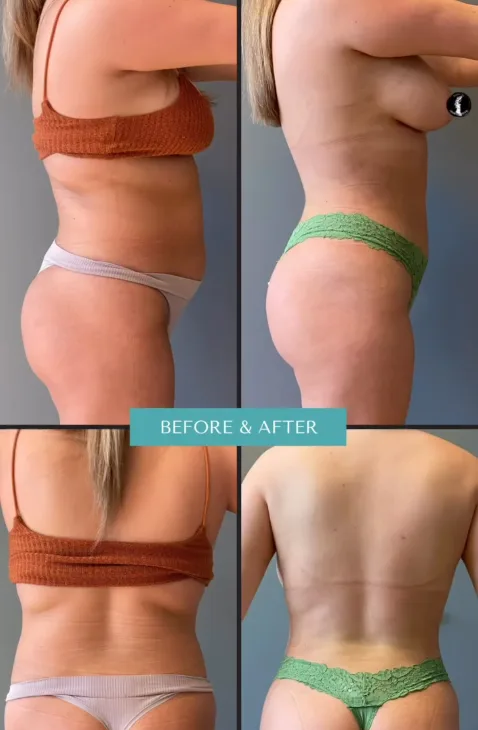
Yes, and surgeons recommend it more often than most patients expect. Lipoabdominoplasty, the clinical term for combining these two procedures, addresses fat deposits, excess skin, and weakened abdominal muscles in a single session. The result is more comprehensive contouring than either procedure can deliver on its own.
| Liposuction | Tummy tuck | Combination | |
|---|---|---|---|
| What it treats | Excess fat | Loose skin, muscle separation | Fat, skin, and muscle together |
| Skin tightening | Mild (via laser or RF) | Yes (surgical excision) | Yes |
| Muscle repair | No | Yes (plication) | Yes |
| Best for | Localized fat with good elasticity | Skin laxity post-pregnancy or weight loss | Both fat and skin/muscle concerns |
Key differences
Surgical fat elimination techniques suction out fat deposits from targeted areas using a thin cannula. It works best when your skin still has enough elasticity to contract on its own afterward.
Loose skin treatment options for your midsection go further by removing excess skin, tightening the abdominal wall, and repairing separated muscles. That muscle repair addresses diastasis recti, a condition that diet and exercise simply can’t fix.
The ASPS explains it simply: liposuction reshapes by removing fat, while a tummy tuck restructures by addressing skin and muscle.
The case for combining
When fat, loose skin, and muscle separation all contribute to the shape of your midsection, treating only one leaves the others unaddressed. Combining both procedures in a single session means one round of anesthesia, one recovery period, and a more balanced result. Dr. Kluska uses SmartLipo laser-assisted liposuction alongside abdominoplasty to sculpt the waistline and tighten the abdominal wall, giving patients a more defined contour than either procedure alone.
That 2018 meta-analysis of 14,061 adult patients confirmed what experienced surgeons already knew: combining the procedures didn’t increase risk. It actually reduced rates of hematoma and seroma compared to traditional abdominoplasty alone.
Who is a good candidate
The best candidates for a combined procedure are non-smokers at or near a stable weight who have both excess fat and skin laxity or muscle separation. You should be done with future pregnancies, since pregnancy can stretch the muscles your surgeon just repaired. If you’re still losing weight, your surgeon may recommend waiting until your weight has been stable for at least six months.
Recovery timeline
Recovery after a combined lipoabdominoplasty is highly individual. It depends on the extent of your procedure, your anatomy and overall health, and the specific aftercare guidance Dr. Kluska gives you. In general, patients plan for time away from their normal routine, wear compression garments while swelling settles, and return to light activity and then fuller activity in stages as they are cleared. Rather than holding yourself to a fixed calendar, follow the timeline your surgeon maps out for your situation.
Cost advantages
A combined procedure typically costs less than having liposuction and a tummy tuck as separate surgeries. You’re paying for one anesthesia session, one facility fee, and one recovery period instead of two. The exact amount depends on the extent of work your body needs, which is something your surgeon determines during a consultation.
If combining these procedures aligns with your goals, reach out to our team to discuss your options in a comfortable, no-pressure setting.
What non-surgical options give you tummy tuck-like results?

Non-surgical treatments have a real place, and Dr. Kluska offers many of them — but it helps to be honest about what they can and can’t do. If your main concern is a modest pocket of fat and your skin still has good tone, a non-surgical option may give you the refinement you’re after. If you have loose, hanging skin or separated abdominal muscles, no non-surgical device can reproduce what a tummy tuck does, because those are structural problems that require removing skin and repairing muscle. The best abdominal results usually come from a plan built around your specific anatomy and goals — sometimes non-surgical alone, often surgery, and sometimes surgery paired with minimally invasive, energy-based skin tightening such as Renuvion or AYON used alongside the excisional procedure for a more refined contour.
Here’s an honest look at the most common non-surgical options, what they realistically achieve, and where they stop short of surgery.
Fat freezing (CoolSculpting)
CoolSculpting uses controlled cooling to target and gradually break down small pockets of fat without incisions. It’s a non-invasive option some practices use for modest, pinchable areas of fat in patients already close to their goal weight.
What it doesn’t do is tighten loose skin or repair separated muscle, so it won’t deliver tummy-tuck results, and it often works slowly and calls for repeat sessions. Notably, Dr. Kluska’s practice no longer offers CoolSculpting; when the real concern is skin laxity or muscle separation, he steers toward approaches that address the structure rather than fat alone.
Radiofrequency skin tightening
Radiofrequency contouring procedures heat deeper layers of tissue to stimulate collagen and encourage gradual skin tightening over the following weeks and months. Several systems exist: some, such as BodyTite, are placed under the skin, while surface devices like Morpheus8 work more topically.
The evidence for these devices is strongest for mild laxity and much weaker for the significant, hanging abdominal skin a tummy tuck addresses. For skin tightening done in conjunction with surgery, Dr. Kluska favors Renuvion — a minimally invasive technology he uses alongside excisional procedures and liposuction to refine the result, which produces a tighter, more natural contour than a non-surgical device used on its own.
Muscle toning (EMSCULPT NEO)
EMSCULPT NEO and similar electromagnetic devices trigger strong muscle contractions to build a little definition, and some pair that with modest fat reduction across a series of sessions.
These devices are about tone, not reshaping. They won’t repair diastasis recti or remove loose skin, so they can’t substitute for a tummy tuck when muscle separation or excess skin is the real issue. At best they’re a maintenance tool — fine for the right goal, but not a path to the structural change surgery provides.
Who gets the best results?
Non-surgical treatments make the most sense for patients close to their goal weight, with localized fat or only mild skin laxity, who want a subtle change without surgery. When the concern is structural — real skin excess or separated muscle, paying repeatedly for non-surgical sessions can cost more over time without ever delivering the result you actually want.
That is the value of a true surgical evaluation. Triple board-certified and with over 25 years of experience, Dr. Kluska pairs an artist’s eye with current techniques like Renuvion to build one comprehensive plan, which might combine a tummy tuck with liposuction, or use a tummy tuck and breast lift combination as part of a mommy makeover, designed around your body rather than a single device. An in-person assessment is the most reliable way to learn which approach fits you.

Is a mini tummy tuck or body lift better after major weight loss?
This largely depends on how much excess skin you have and where it is located. After substantial weight loss, your body can look very different, and the loose skin can be just as troubling as the weight loss itself. Selecting the appropriate procedure involves aligning the surgery with the extent of the issue.
Mini tummy tuck
A mini tummy tuck uses a shorter incision and targets only the lower abdomen, below the belly button. It works well for patients with a mild lower belly pooch and minimal muscle separation. Recovery is shorter, usually one to two weeks, and the scar is smaller than a full tummy tuck.
This approach is ideal after pregnancy, when the excess skin is limited to the lower belly. According to ISAPS, candidates should have good muscle tone and limited stretch marks for the best outcome.
Full and extended tummy tuck
A full tummy tuck addresses the entire abdomen with a hip-to-hip incision, removing excess skin from above and below the belly button while repairing separated muscles. An extended version reaches further around the flanks and is often paired with liposuction for more complete contouring. Recovery takes 4 to 6 weeks, and the scar is more extensive but hidden below the underwear line.
Body lift after weight loss
After major weight loss of 100 pounds or more, a body lift is often the most appropriate choice. The incision extends around the entire torso, removing a belt of excess skin from the abdomen, flanks, back, and sometimes the thighs. A study found that post-bariatric patients can safely combine body lifts with liposuction for improved contouring.
Patients considering a body lift should have maintained a stable weight for at least 6 to 12 months. Recovery is the longest of the three options, typically 8 to 12 weeks before returning to full activity.
Cassie P., a patient who combined medical weight loss with a tummy tuck, shared:
“I went in for medical weight loss and a tummy tuck and both were a great experience! All of the staff members and surgeons were helpful, friendly and were available to answer all of my questions, even after hours! My results are amazing and I never thought that I would have a flat stomach again after having my kids!”
How do you choose the right tummy tuck alternative for your body and goals?
The right option depends on three things: what your skin and muscles look like now, what you want to change, and how much downtime you can handle. No two patients start from the same place, which is exactly why a one-size-fits-all recommendation doesn’t work here.
If your skin quickly returns to its normal position when pinched and your primary concern is persistent fat, liposuction alone might suffice, and everything to know before getting liposuction can help you weigh that option. However, if your skin hangs, sags, or fails to tighten after weight loss, surgical skin removal could be necessary. Additionally, if your abdominal muscles have separated, a tummy tuck or a similar procedure is the only way to restore their integrity.
Your weight also matters. Surgeons typically recommend being at a stable weight for at least 6 months before any body-contouring procedure, as significant fluctuations can affect your results. If you’re still losing weight or planning a pregnancy, it may make sense to wait, and healthcare provider weight reduction plans can help you reach that stable point first.
Then there’s the practical side. Non-surgical treatments involve little to no downtime, while liposuction typically requires a few days to a week off. A full tummy tuck means two or more weeks away from work and several weeks before you can exercise again. Your schedule, your support system, and your recovery environment all factor into the decision.
Because the same team handles your surgical and non-surgical care, many patients also use our medspa for low-downtime maintenance around their procedure — BOTOX®, dermal fillers, a medically supervised weight-loss program, and skin treatments like Diamond Glow facials, dermaplaning, and microdermabrasion — whether to feel refreshed going in or to keep results polished afterward. Patients enrolled in Allē, Allergan’s loyalty program, can also earn rewards toward future BOTOX® and filler visits.
Choosing the right alternative or combination for your body isn’t a decision you have to make in isolation. At Aesthetic Arts, we view the consultation as a two-way conversation in which you can assess whether our approach aligns with your vision. At the same time, your surgeon determines exactly what your anatomy requires to reach your goals.
Because every silhouette is unique, these consultations take place in person at our Commerce, Buford, or Monroe offices. A hands-on assessment provides critical insights into skin elasticity and muscle integrity that photos and descriptions simply can’t capture.
What results, recovery, and risks come with each option?
Every option on the table carries a different timeline for results, a different recovery experience, and a different risk profile. Here’s what to expect across the spectrum.
| Lipo + tummy tuck | Liposuction alone | CoolSculpting | RF skin tightening | EMSCULPT NEO | |
|---|---|---|---|---|---|
| Final results | 6-9 months | 1-3 months | 2-3 months | 2-6 months | 1-3 months |
| Downtime | 2-4 weeks | 3-7 days | None | None to minimal | None |
| Results last | Long-term with stable weight | Long-term with stable weight | Fat cells gone, maintenance needed | Requires maintenance | Requires maintenance |
| Common side effects | Swelling, bruising, soreness | Mild swelling, bruising | Redness, temporary numbness | Mild swelling, redness | Muscle soreness |
Surgical options deliver the most dramatic and lasting changes. With a combined lipoabdominoplasty, final results typically emerge over three to six months as swelling resolves. The vast majority of patients report high satisfaction, with most post-surgical issues being minor and manageable.
Non-surgical alternatives work on a slower timeline, with results that build gradually over two to three months and often need repeat or maintenance sessions to hold over time.
For all options, the most important thing you can do is maintain a stable weight after your procedure. Weight gain doesn’t bring back the exact fat cells that were removed, but it can cause remaining cells to expand and change your contour.
At Aesthetic Arts, surgical procedures take place in an AAAHC-accredited center backed by nearly a thousand Google reviews across three Georgia locations. That track record reflects the consistency of care patients can expect.
View before-and-after results of body-contouring procedures to see what’s possible.
Kayla G., a patient who came in considering lipo but was guided toward a different procedure, shared her experience:
“I initially came to Aesthetic Arts for abdominal lipo, but Dr. Meadows was honest and told me that it would not produce the results I wanted. He explained that a tummy tuck would be a better option and I would be much happier with the results, so that is what I opted to do.”
Conclusion
It’s completely natural to feel like you’re going in circles researching the right procedure for your body. Whether the answer turns out to be liposuction, a tummy tuck, a combined lipoabdominoplasty, or a non-surgical option, the clearest next step is a personal, hands-on assessment that no article or photo gallery can replace.
At Aesthetic Arts, Dr. Kluska and our team believe every patient deserves to feel heard, respected, and confident in their decision. We also work to keep care accessible, with flexible financing through Cherry, CareCredit, Alphaeon, and PatientFi, including 0% APR opportunities, so the investment can be spread into manageable payments.
The gap between the body you have and the body you’ve worked for is smaller than you think, but it requires taking that definitive first step. Don’t spend another season wondering “what if” or settling for results that don’t reflect your effort.
Frequently asked questions
Can liposuction be done instead of a tummy tuck?
It depends on what’s causing the issue. Liposuction can remove stubborn fat, but it won’t tighten loose skin or repair separated abdominal muscles. If your skin has good elasticity and your muscles are intact, lipo alone may be enough.
How long does recovery take after a tummy tuck with lipo?
Most patients take about two weeks off work and return to light activities around four weeks. Full recovery, including strenuous exercise, typically happens by six weeks. Compression garments help manage swelling during the first few weeks.
What is the best non-surgical fat removal for the belly pooch?
There isn’t one best answer, because it depends on what’s driving the bulge. Non-surgical fat-reduction options can help with small, pinchable pockets of fat in patients already near their goal weight, but they don’t tighten loose skin or repair separated muscle. The most reliable way to find the right option is an in-person assessment, where your surgeon can tell whether the issue is fat, skin, muscle, or a combination. If the fat itself is the sticking point, why belly fat resists diet and exercise explains what’s happening underneath.
Do non-surgical tummy tucks work for loose skin?
Treatments like radiofrequency can provide mild tightening, but they won’t produce the same results as surgical skin removal. If your loose skin is significant enough to hang or fold, a surgical option is likely a better fit.
Is a mini tummy tuck enough after pregnancy?
It can be, if the excess skin and fat are limited to the area below your belly button and your abdominal muscles haven’t significantly separated. Your surgeon can determine whether a mini or full tummy tuck better matches your anatomy.
Can you get a tummy tuck after weight loss surgery?
Yes. Patients who have maintained a stable weight for 12 to 18 months after bariatric surgery are often good candidates for a tummy tuck or body lift to address remaining excess skin.
What is diastasis recti, and does lipo fix it?
Diastasis recti is a separation of the left and right sides of the rectus abdominis, the “six-pack” muscles, often caused by pregnancy or significant weight changes. Liposuction cannot repair this separation. A tummy tuck, which includes muscle plication, is the procedure that brings the muscles back together.
How can you tell if you need surgery or a non-surgical option?
If you have loose skin that hangs or folds, or if your abdominal muscles feel separated when you engage your core, surgery is likely the better option. If your skin is firm and your concern is a localized fat pocket, non-surgical options may be effective. A consultation with a board-certified surgeon is the most reliable way to know.
Does insurance cover tummy tuck alternatives?
Insurance may cover a panniculectomy, which removes a large apron of skin that can cause medical issues such as rashes or infections. Cosmetic tummy tucks, liposuction, and non-surgical treatments are typically not covered. Financing through Cherry Credit and CareCredit can help bridge the gap.
Is skin tightening from energy-based devices permanent?
Skin-tightening results from energy-based technologies depend on the approach and on keeping a stable weight, and they continue to evolve as skin naturally ages. When meaningful tightening is the goal, Dr. Kluska often pairs a minimally invasive technology like Renuvion with surgery rather than relying on a device alone, since that combination holds up better for significant laxity.
*Disclaimer: This content is for educational purposes only and does not constitute medical advice. A consultation with a qualified board-certified surgeon is required to determine the best treatment plan for your individual needs and any questions you may have about a medical condition or procedure.